You might have years without having experience
Ten years in one place and five jobs in five years produce the same shallow judgment. Experience is a feedback loop closing on you, not a duration.
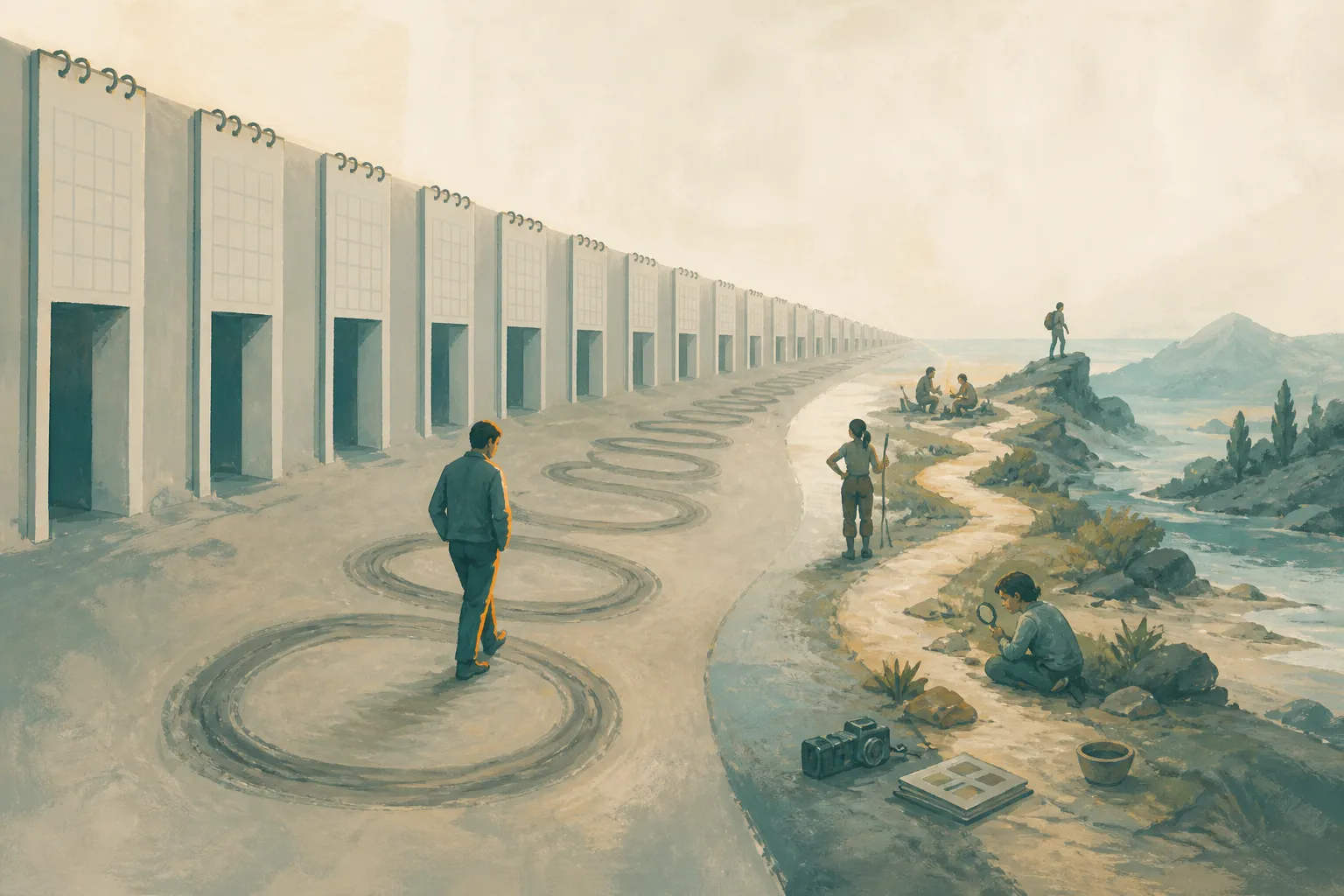
Two very different career shapes that produce the same shallow judgment.
I used to think experience was a function of time. Ten years means something, obviously. It’s on the CV, it’s in the salary band, it’s how the entire industry sorts people into rooms.
Then I met people with ten years who couldn’t handle anything outside their routine, and people with two years who’d been through more than most get through in a decade. So I started paying attention to what the actual difference was, because if it isn’t time, the whole sorting mechanism is measuring the wrong variable.
Two shapes, the same result
The first version is staying somewhere comfortable for a long stretch.
When you’ve been in the same place for ten years, you know what’s coming. The same problems arrive every quarter and you already know how they resolve. So attention drops, because attention is expensive and the environment stopped rewarding it. You stop making genuinely new decisions and start running the thing that worked last time, which works again, because the situation is the same as last time. Then something actually new arrives and there’s nothing to reach for.
The second version looks like the exact opposite. Five jobs in five years, which reads as impressively varied on paper and often is, in the sense that they saw five different environments.
But you’re never anywhere long enough to meet the complexity that only emerges later. You build things, make calls, and leave before you have to maintain any of it. Before you find out what breaks. You skip the hardest part of the work, which is living with your own decisions for long enough to learn whether they were any good. Breadth without depth, and breadth is valuable, it just doesn’t produce the same thing.
Both are about comfort, wearing different clothes. One stayed where it was safe. The other left before it got hard.
What dense experience sounds like
People with real experience can point to specific moments that changed how they think. People with years talk about how long they’ve been there.
That’s the whole tell, and it’s remarkably consistent across every industry I’ve had contact with.
The dense ones say things like “I rebuilt a failing project and here’s what broke eighteen months later, which I did not see coming”. Or “I made a call about the data model that turned out to be wrong, here’s how I know it was wrong, and here’s what I do differently now”. They’ve been in situations that came apart. Unclear requirements, stakeholders wanting opposite outcomes, systems failing in ways nobody planned for. And they stayed long enough for the feedback to arrive.
That’s where judgment comes from. Not from difficulty itself, which is the version of this idea that gets used to justify a lot of unnecessary suffering. From the loop closing on you specifically, while you’re still standing there.
The mechanism, and why the industry keeps missing it
Once you see it as a feedback loop rather than a duration, a few things make more sense.
It explains why some people get very good very quickly. They weren’t more talented. They were placed, usually by accident, in an environment where consequences returned to them fast and unambiguously. Small companies do this by default. Large ones frequently don’t, because the consequences of your decision land in another department eighteen months later and get attributed to something else entirely.
It also explains a failure mode I’ve seen in people with impressive tenure. If you spend a decade making decisions whose outcomes you never observe, you accumulate confidence without calibration, and confidence without calibration is worse than uncertainty, because it doesn’t prompt anyone to check.
And it explains why leaving too early is expensive in a way that’s invisible on a CV. The maintenance period, the bit that’s boring and unglamorous and full of consequences you’d rather not own, is where the learning lands. Skipping it feels like efficiency.
The check
Both paths are tempting, which is why so many people are on one of them. Staying is comfortable. Moving is exciting. Neither is wrong.
So here’s how you find out where you are.
Can you describe a specific failure and what you took from it? Not “that period was hard”, but what decision did you personally make that turned out to be wrong, and how did you find out. And if you’ve moved around a lot, can you point at something you built and say what happened to it six months later.
If you’re drawing a blank on both, you may have years rather than experience. That’s information rather than a verdict, and it’s actionable from tomorrow. The correction is simply to stay somewhere long enough to be wrong in public and watch what happens.
Real experience comes from staying uncomfortable. Taking the ambiguous problems where you don’t have the answer, and sticking around long enough to find out whether you were right.